
Original English clip
Reviewed English source material used for this comparison.
ENGLISH VIDEO TO KOREAN TRANSLATOR
Prepare an English tutorial, feature walkthrough, or training video for Korean-speaking viewers. Choose Korean for the audience, then review formality, labels, numbers, links, and subtitle length before export.
MP4, MOV, and WebM up to 1 GB. Standard translation supports videos up to 8 minutes 20 seconds.
HOW TO TRANSLATE AN ENGLISH VIDEO TO KOREAN
The goal is not only to replace words. It is to prepare a Korean version that makes sense for the people who will watch it.
01
Add an MP4, MOV, or WebM file. The workspace checks the spoken audio from the uploaded video before translation.
02
Choose Korean as the output language for the viewers who will use the training version.
03
Check names, product labels, numbers, links, and wording that needs to stay aligned with the visible training steps.
04
Generate Korean subtitles and translated audio, then export when the translation and subtitle timing are ready to share.
A PRACTICAL USE CASE
Training videos combine spoken instructions with names, product labels, links, and visible steps. Review those details in the Korean translation so viewers can follow the screen and understand what to do next.
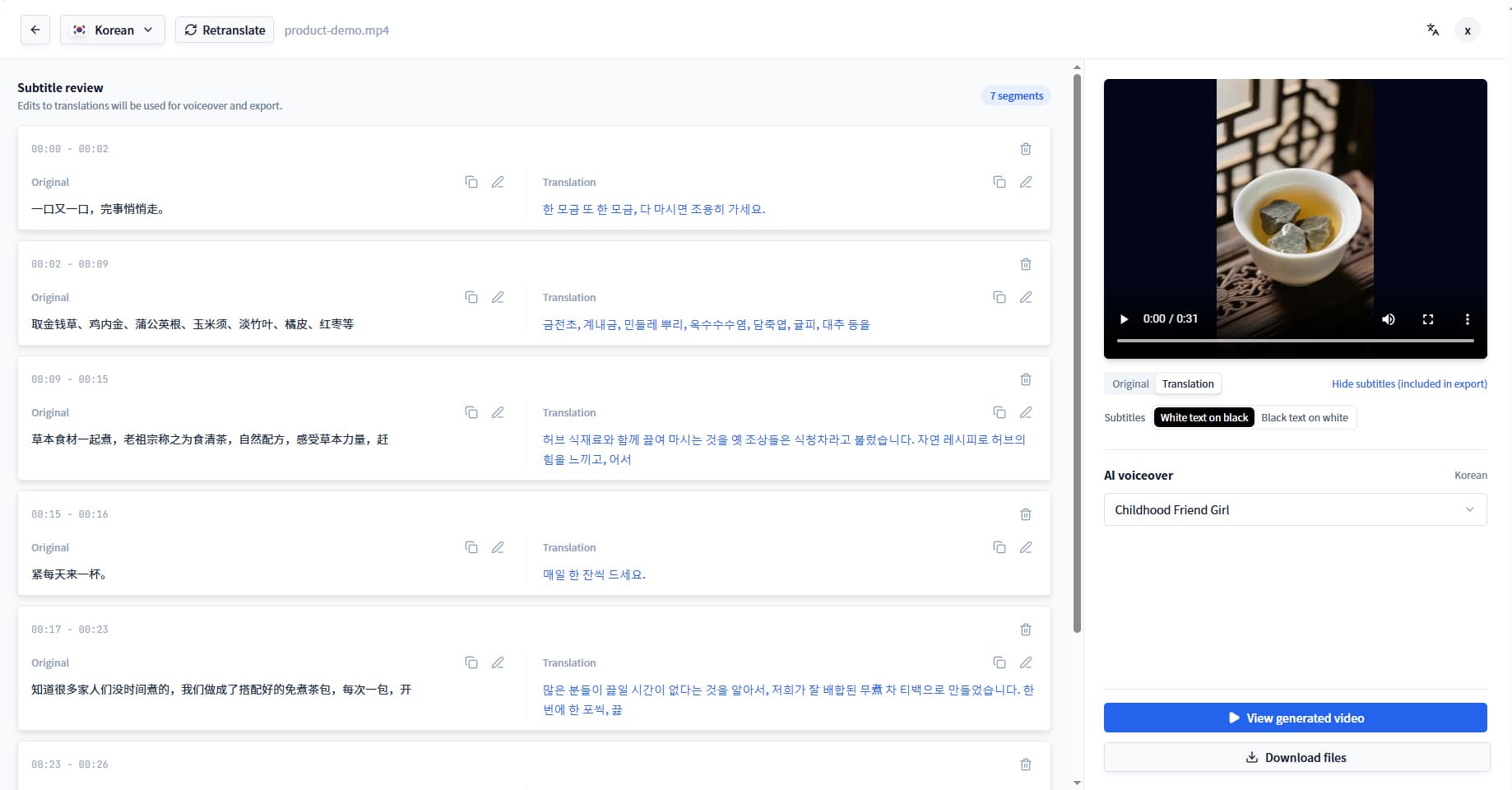
RESULT PREVIEW
These two short clips use the same reviewed English source material and its real rendered Korean standard-dubbing output.
Reviewed English source material used for this comparison.
Real rendered Korean output from the same source clip.
Standard dubbing comparison
This comparison demonstrates a specific sample. Review your own translation, subtitles, and audience terminology before publishing a separate video.
REVIEW BEFORE EXPORT
Use these checks while you review the translated text and subtitles. They are decisions for the person publishing the video, not automatic language rules.
A training video can sound different depending on whether it addresses customers, learners, or an internal team.
Review step: Decide the audience before final review and check important Korean instructions in context.
Viewers need to recognize the name, label, or link that matches the screen they are following.
Review step: Compare these terms with the original recording and visible interface during translation review.
A number, sequence, or instruction that does not match the screen can interrupt a learner partway through a task.
Review step: Check these lines against the source video before generating the final output.
Subtitles should remain readable while viewers also watch the interface or follow a demonstrated action.
Review step: Play the Korean subtitles with the video and revise dense or late lines before export.
Standard dubbing works well for tutorials, product demos, screen recordings, and videos where the speaker is not continuously on camera. It translates the speech without changing the original visual content or lip movements.
Learn about AI video dubbingFor interviews, presentations, and talking-head video, lip sync can align visible speech with the new language. Review both the translated wording and the video delivery before publishing.
Learn about lip sync translationRELATED WORKFLOWS
FILES, LIMITS, AND OUTPUTS
MP4, MOV, or WebM up to 1 GB per file.
Videos up to 8 minutes 20 seconds.
Videos up to 8 minutes.
Localized video plus subtitle and content exports including SRT and VTT.
ENGLISH VIDEO TO KOREAN FAQ
Review the audience, formality, names, product labels, numbers, links, step-by-step instructions, and Korean subtitle timing alongside the source video.
No automatic honorific or cultural-adaptation rule is promised. Review the Korean wording before you export the localized version.
Yes. This page includes a real standard-dubbing comparison from the product. Your own project still needs a review of its terminology, subtitles, and timing before export.
Standard dubbing is a practical fit for tutorials and screen recordings where learning the visible steps matters more than matching a speaker’s mouth movements.
You can upload MP4, MOV, and WebM video files up to 1 GB.
Video processing uses credits. Review the estimated charge in the product before processing begins, and see pricing for the available plans and credit options.
Start the project, review the translation, and export when it is ready to share.